Guerrero Negro: the salt town at the whale lagoon
A company town on the 28th parallel where the world's largest solar salt works shares a lagoon system with the gray whale's nursery and a quarter million shorebirds. A field guide for the people who film industrial-scale landscape, with 598 clips shot here in 2022.
Guerrero Negro at a glance
- Where
- The midpoint of Highway 1, on the 28th parallel that splits the two Baja states, marked by a 36-meter steel eagle.[8] Population 13,596 at the 2020 census.[9]
- The salt
- Exportadora de Sal: the world's largest solar sea-salt operation, around 8 million tonnes a year from a diked pond system of roughly 780 km².[1]
- The whales
- Ojo de Liebre lagoon is a principal gray whale calving ground. Tours run mid-January to the end of March.[7]
- Protection
- Inside the El Vizcaíno Biosphere Reserve, Mexico's largest protected area, and the UNESCO Whale Sanctuary of El Vizcaíno since 1993.[3][4]
- The birds
- A Ramsar wetland and a WHSRN site of hemispheric importance: 250,000+ shorebirds a year, plus wintering black brant.[5][6]
- The name
- Spanish for Black Warrior: an American whaling ship that wrecked at the lagoon entrance in 1858 and named the place.[9]
The story: from whaling ground to whale sanctuary, with salt in between
Guerrero Negro exists because of two extractions, one of which the place survived. In December 1857 the whaler Charles Melville Scammon worked his brig into the lagoon now named after him and found the gray whales' nursery; the rush he started came close to erasing the species. A year later the whaling barque Black Warrior wrecked at the lagoon mouth, and the "Guerrero Negro" name stuck.[9]
The second extraction is still running. In 1954 the American shipping magnate Daniel K. Ludwig founded Exportadora de Sal to feed Pacific industry, and built the company town in 1957. The operation grew into the largest solar evaporation salt works in the world: seawater flooding roughly 33,000 hectares of ponds inside a diked system of about 780 square kilometers, drying under desert sun into around 8 million tonnes of salt a year. It ran for decades as a joint venture between the Mexican government and Mitsubishi, until Mexico bought out Mitsubishi's 49 percent in February 2024 and made the works fully state-owned.[1][2]
The remarkable part is what happened around the industry. The gray whales came back, and the lagoon that nearly finished them became their sanctuary: a biosphere reserve in 1988, a UNESCO World Heritage whale sanctuary in 1993, a Ramsar wetland in 2004. The salt ponds themselves turned out to be world-class bird habitat, hosting more than a quarter million migrating shorebirds a year, a third of the Pacific's marbled godwits, and tens of thousands of wintering black brant geese.[3][5][6] For a camera it is a rare setup: heavy industry and a wildlife sanctuary in one frame, and both are the real thing.
- 1857Scammon enters Ojo de Liebre and finds the gray whale nursery. The slaughter that follows nearly wipes out the species.[9]
- 1858The whaling barque Black Warrior wrecks at the lagoon entrance and gives the place its name.[9]
- 1954Daniel K. Ludwig founds Exportadora de Sal; the company town follows in 1957.[1]
- 1988The El Vizcaíno Biosphere Reserve is decreed: about 2.5 million hectares, Mexico's largest protected area.[4]
- 1993UNESCO inscribes the Whale Sanctuary of El Vizcaíno, covering the Ojo de Liebre and San Ignacio lagoons.[3]
- 2004The Ojo de Liebre lagoon complex is designated a Ramsar wetland; hemispheric shorebird recognition follows in 2009.[5]
- 2022Phil Maher films the salt works, dunes, and lagoon shore in July. That shoot is this library.
- 2024Mexico buys out Mitsubishi's stake; the world's largest salt works becomes fully state-owned.[2]
The filming calendar
| Months | What is happening |
|---|---|
| Jan-Mar | Gray whale season. Tours run roughly January 15 to March 31; February and March are the peak, with operators reporting 1,500 to 2,000 mothers and calves in the lagoon at once, many of them "friendly" whales that approach the pangas.[7] |
| Apr-Jun | Whales head north. Shorebird migration moves through the pond complex in spring; the salt works runs year-round. |
| Jul-Sep | Fog-cooled desert summer on this Pacific coast, far milder than the gulf side. Hurricane season is officially May 15 to November 30, with Baja's highest risk August through October. This library's shoot was July. |
| Oct-Dec | Wintering black brant arrive on the eelgrass, tens of thousands of them, and the first gray whales return late December.[6] |
The footage: 598 clips of salt, dunes, and birds
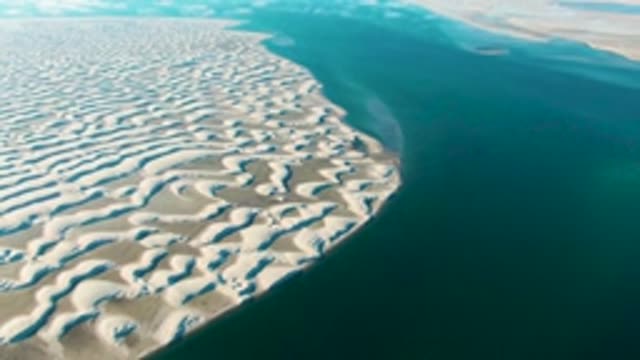
This is the July 2022 shoot: 598 clips, nearly all 4K, all licensed direct. The core is the thing almost nobody films: the salt works itself, from the air and the ground. Evaporation ponds running to the horizon in bands of color, conveyors pouring white mountains, the barge canal, and the machinery of an operation that ships 8 million tonnes a year. Around it: white dunes meeting turquoise water, herons and egrets working the shallows, shorebirds on the flats, and the company town's streets. Honesty note: no gray whales; the shoot was July and the whales are a winter story. If your edit needs breaches, pair this footage's establishing and industry material with wildlife footage from a winter shooter. 564 of the 598 clips have nobody in frame.
Hover any card to play the preview, or use the quick-look button to check a clip without leaving the page.
Find the shot
A working shot list for a Guerrero Negro edit
The sequence a salt-industry, conservation, or Baja road-trip edit needs, with each row linking into the live catalog.
| Story beat | Look for | Start here |
|---|---|---|
| The scale | Aerials of evaporation ponds running to the horizon | Pond aerials |
| The industry | Conveyors, salt mountains, the barge canal | Salt works |
| The sanctuary | Dunes, turquoise shallows, the lagoon shore | Dunes · lagoon |
| The wildlife | Herons, egrets, and shorebirds in the shallows | Herons · birds |
| The town | Company-town streets and neighborhoods | Guerrero Negro hub |
| The road | Highway 1 and the desert around it | Road clips |
Licensing, in one paragraph
Every clip licenses today, direct from the filmmaker: $79 for the royalty-free standard license, $199 for extended broadcast use. The clean master downloads the moment payment clears, a license certificate PDF comes with every order, and every clip has a free watermarked preview you can cut into a timeline before spending anything. Most clips here are landscape and industry with nobody in frame; where a person is recognizable, the clip page says so. The salt works is private industrial property, so treat facility footage as editorial-first and check the clip page. The license page has the full terms and the direct-vs-marketplace comparison covers when a subscription site is the better deal.
Guerrero Negro FAQ
What is Guerrero Negro known for?
Two things at world scale: the largest solar evaporation salt works on Earth, producing around 8 million tonnes a year from a diked pond system of roughly 780 square kilometers, and the Ojo de Liebre lagoon next door, one of the gray whale's principal calving grounds and part of the UNESCO-listed Whale Sanctuary of El Vizcaíno.[1][3]
When is gray whale season at Ojo de Liebre?
Tours run roughly January 15 to March 31, with February and March the peak, when operators report 1,500 to 2,000 mothers and calves in the lagoon at once. Around 20,000 gray whales migrate to the Baja lagoon complex each winter.[7][6]
Who owns the Guerrero Negro salt works?
The Mexican state. Exportadora de Sal (ESSA) was founded in 1954 by American shipping magnate Daniel K. Ludwig and ran for decades as a 51/49 joint venture between the Mexican government and Mitsubishi, but in February 2024 Mexico bought out Mitsubishi's stake and ESSA became 100 percent state-owned.[2]
Why is the town called Guerrero Negro?
It is Spanish for Black Warrior, after the American whaling barque Black Warrior that wrecked at the lagoon entrance in December 1858. The lagoon took the ship's name, and the company town founded in 1957 to serve the salt works took the lagoon's.[9]
What is the eagle monument at Guerrero Negro?
A 36-meter steel eagle marking the 28th parallel, the state line between Baja California and Baja California Sur, at the entrance to town. Crossing it also crosses a time zone.[8]
Does this library have gray whale footage?
Not from Guerrero Negro; this shoot was in July, months after the whales leave. What it has is everything around them: the salt works from the air, the conveyors and barge canal, the dunes meeting turquoise water, herons and shorebirds, and the company town itself, footage that is much harder to find than whale breaches. For drone humpbacks, see the East Cape guide.
How is the footage licensed?
Direct from the filmmaker: $79 for the royalty-free standard license or $199 for extended broadcast use, per clip. The clean master downloads the moment payment clears, a license certificate PDF comes with every order, and every clip has a free watermarked preview.
Do these clips need releases?
Rarely: 564 of the 598 clips have nobody in frame. Where a person is recognizable, the clip page carries a release notice, and the license page explains releases in plain terms.
Sources
- Wikipedia. "Exportadora de Sal S.A." (founding, scale, pond area, production). en.wikipedia.org
- Mexico News Daily. "Mexico nationalizes world's largest sea salt plant in Baja California Sur" (February 2024 buyout). mexiconewsdaily.com
- UNESCO World Heritage Centre. "Whale Sanctuary of El Vizcaíno" (inscribed 1993). whc.unesco.org/en/list/554
- Wikipedia. "El Vizcaíno Biosphere Reserve" (1988, ~2.5 million ha, Mexico's largest protected area). en.wikipedia.org
- WHSRN. "Complejo Lagunar Ojo de Liebre / Guerrero Negro" (site of hemispheric importance, shorebird percentages). Ramsar site no. 1339, designated 2004. whsrn.org
- Pronatura Noroeste. "Guerrero Negro: Ojo de Liebre wetlands, whale and shorebird sanctuary" (250,000+ shorebirds, ~20,000 migrating gray whales). Terra Peninsular on wintering black brant. pronatura-noroeste.org · terrapeninsular.org
- Kuyima (whale-watching operator). "Whale season in Guerrero Negro" (tour dates, peak months, lagoon counts are operator estimates). kuyima.com
- Discover Baja. "Baja monuments" (the 28th-parallel eagle, 36 m). discoverbaja.com
- Wikipedia, "Guerrero Negro" (1957 founding, 2020 population). BajaBound Baja history, the Black Warrior wreck and Scammon's 1857 entry. en.wikipedia.org · bajabound.com
Whale counts inside the lagoon are operator estimates and the text says so; the migration figure is the population estimate conservation groups publish. If you are writing about Guerrero Negro, cite the primary sources directly; they are linked so you can. Spot an error? Tell us through the about page and we will fix it and note the change.
Keep reading
- The Guerrero Negro collection, all 598 clips.
- The La Bocana guide, the Pacific fishing coast to the south.
- The East Cape guide, where this library's drone whale footage lives.
- Wildlife and aerial footage across the library.