La Bocana: Baja's lobster coast
A thousand-person fishing town on the Pacific's fog-cooled Vizcaíno coast, 81 km of desert off the highway, whose cooperative helped earn the developing world's first MSC-certified artisanal fishery and runs the world's only commercial blue abalone farm. A field guide for the people who film working coasts, with 1,208 clips shot here in 2022.
La Bocana at a glance
- Where
- The Pacific coast of Mulegé municipality, at the mouth of the Estero La Bocana, about 2.5 hours south of Guerrero Negro. Population 1,013 at the 2020 census.[6]
- The road
- A paved turnoff from Highway 1 crosses 81 km of empty desert to Punta Abreojos; La Bocana sits about 10 km further along the salt flats.[7]
- The cooperative
- Progreso, founded 1944: lobster, abalone, and sea cucumber, part of the FEDECOOP federation.[1]
- The certification
- FEDECOOP's red rock lobster fishery: MSC-certified in 2004, the developing world's first artisanal fishery to earn it, recertified three times.[2][3]
- The abalone
- A farm reported as the world's only source of commercial-size blue abalone, exported live to China.[4]
- The setting
- The El Vizcaíno reserve region, Mexico's largest wildlife refuge, with the gray whale lagoons up the coast.[5]
The story: the cooperative coast
La Bocana is what a fishing town looks like when the fishing works. In 1944, twenty-six fishermen at a camp south of the estero formed the cooperative that became Progreso, and the town has run on lobster, abalone, and sea cucumber ever since.[1] In 1992 Mexico granted the coast's cooperatives exclusive territorial fishing concessions, and the bet paid off publicly in 2004, when the FEDECOOP federation's red rock lobster fishery earned Marine Stewardship Council certification: the first artisanal, community-based fishery in the developing world to do it, among the first ten MSC fisheries anywhere, hand-set traps from small skiffs and all. It has been recertified three times since.[2][3]
The quieter superlative is on land: a farm decades in the making that journalists report as the only one in the world raising blue abalone to commercial size, exporting live animals as far as China, with the cooperative now pushing toward the first commercial sea-based blue abalone mariculture.[4] All of it happens on a coast most maps ignore: the fog-cooled Pacific side of the Vizcaíno desert, inside the region of Mexico's largest wildlife refuge, where the estero's mangrove channels hold herons, rails, and ospreys nesting on poles the fishermen put up for them.[5][8]
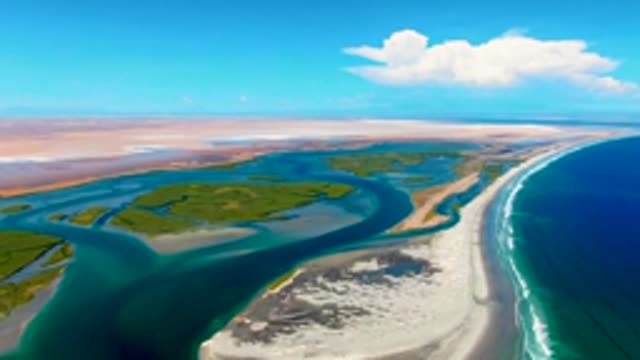
For a camera, La Bocana is the working-coast frame that stock libraries almost never have: pangas and lobster crates instead of resorts, a green estuary splitting white dunes, and 200 yards of empty right-hand point break at Punta Abreojos next door when the south swells run.[7]
- 1944Twenty-six fishermen found the cooperative that becomes Progreso de La Bocana.[1]
- 1988The El Vizcaíno Biosphere Reserve is decreed across this region: about 2.5 million hectares.[5]
- 1992The coast's cooperatives receive exclusive territorial fishing concessions.[3]
- 2004FEDECOOP's lobster fishery earns MSC certification, a first for artisanal fisheries in the developing world.[2]
- 2019The Punta Abreojos road is paved, cutting the desert crossing to a pothole slalom instead of a washboard one.[7]
- 2022Phil Maher films the estero, the surf, the birds, and the fishing fleet in July. That shoot is this library.
- 2026The cooperative works toward the first commercial sea-based blue abalone mariculture.[4]
The filming calendar
| Months | What is happening |
|---|---|
| Jan-Apr | Gray whale season at the San Ignacio and Ojo de Liebre lagoons up the coast, inside the same El Vizcaíno region. La Bocana stays a working fishing town while the tour traffic goes north. |
| May-Jun | Spring is the reliable window for the Punta Abreojos point breaks on south-southwest groundswells, per surf-guide reporting.[7] |
| Jul-Sep | Fog-cooled desert summer, far milder than the gulf side; the estero's bird life is dense year-round. Hurricane season risk peaks August to October. This library's shoot was July. |
| Oct-Dec | The Pacific lobster season economy is in full swing and the first gray whales pass south late in the year. Morning fog, soft light, empty beaches. |
The footage: 1,208 clips of a working coast
One July 2022 shoot, and the largest Pacific-side collection in this library: 1,208 clips, nearly all 4K, all licensed direct. The star is the estero itself from the air: green channels and sandbars braiding into the surf line, dunes on one side, town on the other. Around it: 714 wave clips off the points and beaches, 200 bird clips (pelicans, herons, shorebirds working the flats), the fishing fleet, lobster crates and the cooperative's dockside work, and a kid fishing off a blue panga. Honesty note: no gray whales (wrong season, and the lagoons are up-coast) and no abalone-farm interiors. 1,076 of the 1,208 clips have nobody in frame.
Hover any card to play the preview, or use the quick-look button to check a clip without leaving the page.
Find the shot
A working shot list for a La Bocana edit
The sequence a sustainable-fishery, food-origin, or working-coast edit needs, with each row linking into the live catalog.
| Story beat | Look for | Start here |
|---|---|---|
| Establish the place | Aerials of the estero mouth braiding into the Pacific | Estero aerials |
| The fleet | Pangas, moorings, and the working waterfront | Boat clips |
| The catch | Lobster crates and dockside handling | Lobster clips |
| The ocean | Point-break walls and empty beach surf | Wave clips |
| The wildlife | Pelicans, herons, shorebirds on the flats | Bird clips |
| The desert edge | Dunes and the empty coast beyond town | Dune clips |
| The region | Salt and whales at Guerrero Negro up the coast | Guerrero Negro guide |
Licensing, in one paragraph
Every clip licenses today, direct from the filmmaker: $79 for the royalty-free standard license, $199 for extended broadcast use. The clean master downloads the moment payment clears, a license certificate PDF comes with every order, and every clip has a free watermarked preview you can cut into a timeline before spending anything. The fishing scenes include working people; recognizable faces carry a release notice on the clip page, and the license page explains releases in plain terms. The direct-vs-marketplace comparison covers when a subscription site is the better deal.
La Bocana FAQ
Where is La Bocana?
On the Pacific coast of Mulegé municipality, Baja California Sur, at the mouth of the Estero La Bocana, about two and a half hours south of Guerrero Negro. The paved Punta Abreojos road leaves Highway 1 and crosses 81 km of empty desert; La Bocana sits about 10 km beyond Punta Abreojos along the salt flats. Population 1,013 at the 2020 census.[6][7]
Why does La Bocana's lobster matter?
The town's cooperative, Progreso, founded in 1944, belongs to FEDECOOP, the federation whose Baja California red rock lobster fishery earned Marine Stewardship Council certification in 2004: the first artisanal, community-based fishery in the developing world to do it, among the first ten MSC fisheries anywhere, and recertified three times since. Hand-set traps from small skiffs, managed by community concessions.[2][3]
What is the blue abalone farm at La Bocana?
A land-based farm, decades in the making, reported as the only one in the world producing commercial-size blue abalone and exporting live animals to China. The cooperative is now working toward the first commercial sea-based blue abalone mariculture.[4]
Is there surf at La Bocana?
The zone's famous waves are the right point breaks at Punta Abreojos next door, best on south-southwest groundswells with spring a reliable window, and rarely crowded. Note for researchers: the surf spot listed as "La Bocana" on most surf databases is a different break near San José del Cabo.[7]
Can you see whales from La Bocana?
The gray whale calving lagoons, San Ignacio and Ojo de Liebre, lie up the coast inside the same El Vizcaíno region and run January through April. La Bocana itself is a fishing and estuary story rather than a whale-tour town. The Guerrero Negro guide covers the lagoons.
What is in this footage library from La Bocana?
1,208 licensed 4K clips from a July 2022 shoot, the largest Pacific-coast collection in this library: estuary aerials where sandbars meet the surf, 714 wave clips, 200 bird clips, fishing boats and the cooperative's lobster work, dunes, and pelicans. No gray whales; wrong coast season.
How is the footage licensed?
Direct from the filmmaker: $79 for the royalty-free standard license or $199 for extended broadcast use, per clip. The clean master downloads the moment payment clears, a license certificate PDF comes with every order, and every clip has a free watermarked preview.
Do these clips need releases?
Sometimes: the fishing scenes include people, and 1,076 of the 1,208 clips have nobody in frame. Where a person is recognizable, the clip page carries a release notice, and the license page explains releases in plain terms.
Sources
- Government of Baja California Sur (SEPADA). "Celebran 75° aniversario de la Cooperativa Progreso de La Bocana" (founded 1944; lobster, sea cucumber, abalone). sepada.bcs.gob.mx
- Marine Stewardship Council. Mexico Baja California red rock lobster fishery record and recertification news (2004 first, first ten worldwide, three recertifications). fisheries.msc.org · msc.org
- Environmental Defense Fund, Fishery Solutions Center. "Mexican Baja California FEDECOOP" (1992 territorial concessions; first small-scale fishery in a developing country certified). fisherysolutionscenter.edf.org
- Zona Docs / Causa Natura Media (June 2026). "De la tierra al mar: La Bocana busca desarrollar el primer maricultivo comercial de abulón azul." zonadocs.mx
- SEMARNAT. "Reserva de la Biosfera El Vizcaíno" (1988 decree, 2,546,790 ha). gob.mx/semarnat
- INEGI census data via City Population, "Estero de la Bocana" locality (1,013 at 2020). citypopulation.de
- Viva Baja road guide (the Abreojos highway, paved 2019; the salt-flat road to La Bocana). The Bobi Book, Punta Abreojos (81 km of desert; the point breaks). Surf-forecast, Punta Abreojos (swell and season). vivabaja.com · thebobibook.com · surf-forecast.com
- BajaBound, "Campo Rene" (osprey nesting poles; the cooperatives' stewardship of this coast). Birds of Passage, Estero La Bocana birding report. bajabound.com · birdsofpassage.wordpress.com
Small-town facts are harder to source than famous-park facts, so this page leans on the state government, the MSC's own records, and named journalism, and labels road and surf details as the traveler-level reporting they are. If you are writing about La Bocana, cite the primary sources directly; they are linked so you can. Spot an error? Tell us through the about page and we will fix it and note the change.
Keep reading
- The La Bocana collection, all 1,208 clips.
- The Guerrero Negro guide, salt and gray whales up the coast.
- The La Paz guide, the capital on the gulf side.
- Ocean and wildlife footage across the library.